

About the SPSympo scientific conference
The Signal Processing Symposium (SPSympo), initiated in 2003 by Prof. Krzysztof Kulpa, has for over 20 years served as a platform for knowledge exchange among researchers, industry practitioners, and doctoral students from around the world working in the broad field of signal processing. During this year’s edition, held at the Institute of Electronic Systems at Warsaw University of Technology, papers were presented on topics including object tracking, radio wave analysis, vibroacoustics, waveform modeling techniques, and the application of various machine learning methods and artificial intelligence algorithms in processing collected signals. The conference also featured a series of workshops, mainly aimed at students, covering passive airborne radar, programming issues, and methods for analyzing spatial and temporal patterns.
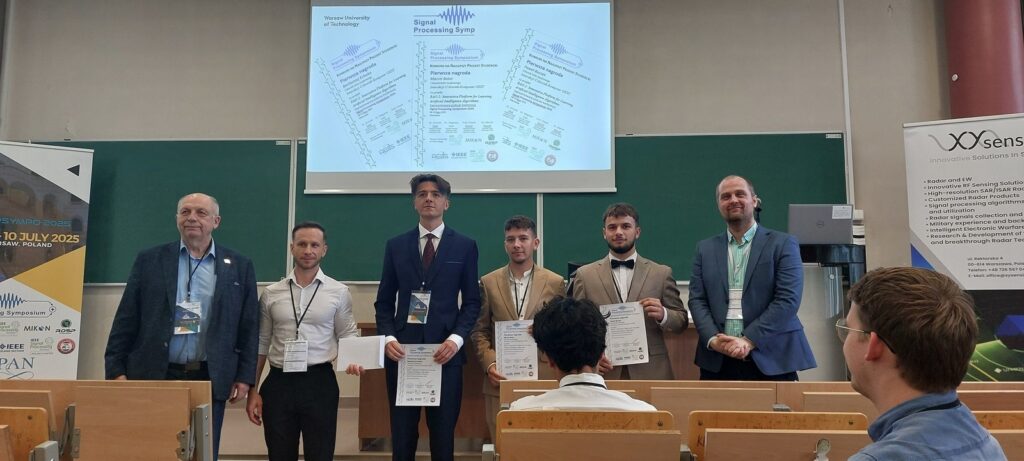
Additionally, the organizers prepared a competition for student scientific clubs for the best student project in the broad field of signal processing. A team of third-year Computer Science students, consisting of Marcin Bator, Paweł Buczek, and Bartłomiej Krówka, representing the scientific club Human-Computer Interaction GEST (link to the club's website) at the Department of Computer and Control Science, was selected for the competition final by the jury. During the final, the GEST club team defeated scientific clubs from Wrocław University of Science and Technology and Poznań University of Technology, securing 1st place.
Rzeszów University of Technology Games for Artificial Intelligence 2.0 educational platform
The main goal of the educational platform created by students of Rzeszów University of Technology, Rzeszów University of Technology Games for Artificial Intelligence 2.0 (RAG-2) (link to the platform's website), is to facilitate students’ learning and the development of their own artificial intelligence algorithms. The platform is designed to provide users not only with a variety of online games but also with all essential information regarding the ongoing gameplay. The exact dataset and the frequency of data collection can be customized, and the process itself is fully automated.
Data can be collected by playing solo, with friends, against AI agents designed by the GEST club students, or by connecting your own algorithms to the platform. To facilitate learning, the project creators have provided a Python program template that allows users to connect to the platform and only requires adding their own algorithm to control the gameplay. Step-by-step instructions are also available to guide users in setting up the connection. The platform supports various control methods, from classic ones like keyboard and mouse to more advanced options such as hand gesture control recognized by a webcam. Currently, students are working on a dedicated mobile application to serve as a controller and on integrating Eyetracker support, enabling gameplay using eye movement.
The platform developed by the GEST scientific club also allows users to create an account using a student or staff email, providing access to the history of recorded games and unlimited use of the platform’s built-in bots. Teachers at Rzeszów University of Technology can also set up a virtual class group, enabling them to monitor the progress of students assigned to it. All those interested in testing the platform and sharing feedback or suggestions are encouraged to contact via the email provided in the footer of the website (contact email).
Activities of the GEST club
The scientific supervisor of the project is Dr Eng. Dawid Kalandyk, who also leads teams within the Human-Computer Interaction GEST scientific club focused on developing autonomous mobile robots and applications. These solutions aim not only to facilitate learning of artificial intelligence and sign language but also to support people with disabilities and their communities communicating through Polish Sign Language. The solutions developed by the club not only improve the daily life and comfort of people with disabilities but also represent a significant contribution to combating the social exclusion of this group.